
Dear Artist,
This fall we’re producing a new book. It’s a fat, biblical-looking tome that will contain all of the twice-weekly letters so far. Since I started this venture on July 22, 1999 there have been 1,042 letters. As well as assembling them in chronological order, we’re building a really useful index.
We’re also planning a significant foreword that I’m asking readers to write.
Here’s how we think it may work: We need three separate forewords by three different authors. We’d like each of these forewords to be up to 500 words — about the length of a twice-weekly letter. Your foreword might contain what you have gained from the letters or any insights you might wish to write about. The writing can be praiseful, candid, humorous, critical, or whatever. That said, we retain the right to edit — and we’ll check our decisions with you. Ideally, we’ll receive a pile of submissions. Our selection will be based on your brilliance as well as how your foreword might fit in with the others. Every submission will be taken seriously and read by me.
Successful contributors will be bylined and given ten copies of the finished book. Our deadline for the forewords is September 20, 2009. The book launch (on the Painter’s Keys site) is set for November 28. Please give our idea some consideration. If you feel your prose may be substandard, we have professional copy editors who will make you look good. They’ve been doing it for me for some time. Please send your submission in any format here.
Our book’s title is The Twice-Weekly Letters, July 22, 1999 – September 29, 2009. It’ll sell for about $30.
Writing to you twice a week has been a lot of fun and a great growth curve at this end. You might say I’ve found out what I think about a lot of things, and by the feedback we get every hour of every day, except for the odd gripe, it seems others have, too. I’ve learned so much from our subscribers. As with all my projects, I’m entering this one with a fair degree of trepidation. In retrospect, the early letters are pretty lightweight. Some of the later ones I can’t fully understand myself. Nevertheless, we’re shouldering through with minimal editing and offering our fat book with all its slubs and bumps.
And no, this doesn’t mean I’m going to stop writing to you twice a week. I have this obstinate idea that I haven’t yet come to the bottom of the subject.
Best regards,
Robert
PS: “By and large books are mankind’s best invention.” (Ursula K. LeGuin)
Esoterica: The twice-weekly letters are really conversations among the brotherhood and sisterhood of artists. In curiosity and convention, in ignorance and perhaps a little bit of truth, these twice-weekly missives have been laid one to the other like stepping stones through an often puzzling landscape. Bound together in one volume, they will, I hope, be given further life. Besides, long books are difficult to delete. “One always tends to over-praise a long book because one has got through it.” (E. M. Forster)
Gift to all artists
by Andrea Loeppky

“Tire tracks on the curve”
acrylic painting
by Andrea Loeppky
I don’t know that I have the necessary skills and experience to be able to write your foreword but I want to say this. I am so looking forward to your compilation of the Letters. What an amazing gift to all artists. Whether as painters just getting started, or quite accomplished, I believe that the creative journey is never over. I have found so many of the twice-weekly letters relevant and helpful, not to mention very amusing at times. In fact, sometimes I get butterflies in my stomach while reading your letters, thinking, “Oh, this is exactly what I wanted to know.” I will certainly be purchasing a copy for myself as well as a bunch for my artist friends who mean a lot to me. I seriously wonder how you do it all. How the heck do you ever have time to paint?
There is 1 comment for Gift to all artists by Andrea Loeppky
Early morning missives
by Paula Timpson
Early morning, artists float upon silent messages, hope received, courage gathered, dreams and reality, opened as One. The Painter’s Keys have been a light, a connection through the path of a deep, dense forest… for, by discovering other ways to ‘see’ I have found grace internally. The Painter’s Keys is for everyone, all creative souls , realizing their way in today’s world. As a Poetess, I have appreciated the incoming ideals; dreamer that I am, reality, complete with a vision of a better world by ‘giving’ our art; our bare souls. Reaching high, artists must trust themselves, which is challenging in a world that chases worldly concerns. Art in its purest form is truth; a teaching for all who truly possess open-hearts. Freedom is in simply ‘doing’ our art, finding our spirits lifted by the creations that arise; as writers write and painters paint.
Giving back
by Mark Brennan, Whitehill, Nova Scotia, Canada

“Bend in the river”
oil painting
by Mark Brennan
“Artist, gain knowledge, but know that the greatest guru of all is the guru within.” That’s the beauty of Robert’s writing. In his own subtle way he leaves it to you, the reader, to find the guru within.
The Complete Letters will not be a ‘how to’ of painting; it is however an invaluable tool that reaches art lovers and aspiring or successful artists of all disciplines on a deeper level. Readers will return to it again and again to gain insight into their own work and to gather appreciation of the fascinating and beautiful world of what it means to create and express ourselves as humans. In the years to come, Robert’s book will no doubt stand as a lasting tribute to one of Canada’s best loved painters and writers. It’s his way of giving back, of saying thank you to a treasured lifetime in the visual arts.
Faithful writer
by Susan Holland, Bellevue, WA, USA

“France – Alley 1”
oil painting
by Susan Holland
Robert Genn has “been there, done that” for us, folks, and has the skills to share it in a very palatable manner. Printouts of Robert’s wisdom and lore get taped to doorways and easel-tops. His 12 Steps for painters, for instance!
I have received his “Twice-Weekly Letters” for ten years and while I don’t always have an “aha,” it likely is not the fault of Robert Genn, but the fault of my own lapse in teachability. Robert has real paint under his fingernails and real sweat on his brow. While his art often looks effortless, it is a product of lots of paint, sweat, and also tiresome but necessary issues like marketing and public relations. It is remarkable that this busy man also wants to share his findings with other artists badly enough to write faithfully. As I have done with Painter’s Keys, I will cheerfully buy copies of this new compendium and give copies to my close artist friends who can place it alongside The Art Spirit, by Robert Henri, which is my other perennial coach.
There are 2 comments for Faithful writer by Susan Holland
Rich with thoughts
by Marion Boddy-Evans, Isle of Skye, Scotland

“Seascape No.10” acrylic painting
by Marion Boddy-Evans
I don’t recall when I started reading Robert’s letters, but it seems like it’s always been appearing in my email inbox as an inspirational highlight amongst the must-do, buy-now, and please-help emails. If only I had had a dollar every time one of my own newsletter readers has asked if I read Genn’s wonderful/ brilliant/ choose-your-adjective letters I would have been able to enjoy quite a number of boxes of chocolates while reading his wonderful/brilliant/choose-your-adjective letters, which always leave me rich with thoughts.
Groping around
by Corrine Bongiovanni, Windham, ME, USA

“The Yellow Dinghy”
watercolour painting
by Corrine Bongiovanni
If you’ll recall Cracker Jacks and the prize tucked inside each of those little rectangular boxes, you’ll have a visual for how I contextualize the value of the Letters. Amidst the jacks which are typically thought generating and often humorous, there is almost always a prize kernel of insight, new information, or just a different perspective. Sometimes the usefulness of advice offered (ie: glazing keys) is valuable, but more often, I read the letters in search of that prize kernel that will spark a new view, an original thought, or simply broaden my mental scope. To that end, I appreciate the inclusion of quotes. Robert, occasionally the letters feel as though you’re struggling to either create something of worth or groping around yourself to develop an idea that began as too small a kernel and just won’t pop! But, I’ve learned to enjoy those pieces too. Trying to “grope around with you” has sometimes stirred up bits of new awareness for me or at least gotten me thinking and pondering. Please keep the brain functioning and the letters flowing.
Joyful anticipation of next letter
by Kay Christopher, TX, USA

Kay Christopher
I am so happy to hear you are putting your Letters into a tome. It will be great to have them all together. You will have to make volume two after you do some more writing. I’m so very grateful to you for writing the letters in the first place, for creating the community of readers and their valuable commentary, for getting us to think about all kinds of things we would not have otherwise considered, for the consistency with which you send them which allows a joyful anticipation of the next letter, for the way you expose yourself in a bold and good way (like when you had readers critique your painting and the way you give your opinion even if you think it might not be popular), for being an example of a financially and otherwise successful artist, and for being very inspiring in a multitude of ways.
The nectar of life
by Justin R Christenbery, Charlotte, NC, USA
Robert has given a great gift in these letters. They act as practical guides to engaging and resolving unforeseen creative obstacles as well as the glaringly obvious-but-unavoidable kind. They also serve to remind us of the sacred mission — the necessity of our mules’ reaching the canyon’s rim. There our people await our arrivals, whether they know it or not. In traveling to those places of depth and perspective infrequently encountered by others, we are able to harvest the nectar of life. The fruits we deliver, whatever their properties, remind those that taste them of lands and possibilities beyond their own. In witnessing our flights, the earth-bound begin to remember their own wings, long forgotten beneath layers of protective clothing as they may be.
The blessing/curse syndrome
by Jane Prete, Clayton, NC, USA

“Branch”
original painting, 18 x 24 inches
by Jane Prete
I am alone most of the time. Most of my solo time is intentional and needed. When I socialize with non artists, I am thinking and painting in my head. It becomes both a blessing and a curse. Having issues and joys related to my paintings many times are buried and unresolved. My world becomes color, composition, frustration, exultation and all the rest of the creativity bottled up inside. Some days I think, what am I doing and why? Am I losing my edge? Will this painting ever be resolved? And as the week flies by, “Isn’t this a wonderful painting?” Yes, you bet it is I say. Perhaps it’s a masterpiece. How will I know? Finally it’s happened. A painting unlike all other ideas. Do I have anything at all to crow about? Then, that last stroke. What was I thinking? It’s a disaster. Questions, answers, doubts, giggles, ideas and turning the paper over. Painting three or more coats of Gesso on a canvas. All part of the blessing/curse syndrome.
Then — it comes, a letter from Robert Genn. I dissolve into my computer chair, sometimes smiling, sometimes tearing up and many times feeling totally overwhelmed that another person feels and shares my thoughts. Clarity. And, I’m not alone. Thank you for being there Robert Genn. You are needed.
There is 1 comment for The blessing/curse syndrome by Jane Prete
Inclusion of clickback material?
by Karen Matte

“At the End of the Lane”
original painting, 9 x 12 inches
by Karen Matte
I often find it useful to go to the clickback referenced in the letter. Will you include some or all of those images in your new book?
(RG note) Thanks, Karen. We thought long and hard about that one. To properly illustrate even a percentage of those valuable clickbacks we would have to produce a fat book annually. Perhaps we’ll tackle that project another time. For the time being, all previous clickbacks — going back to when we started them — are archived for your use on the Painter’s Keys site. There’s an index to them here.
An arrogant, pompous ass
by Ed
You are an arrogant, pompous ass to believe that anyone with a life might wish to read your decade of biased ramblings about much of nothing. To believe that someone might seek out and actually purchase a book and spend precious time solely for the purpose of perusing your rants and supercilious, self-styled, narrow-minded opinions is beyond comprehension. Are you really that pretentious? Somehow, you must feel you are a legend in your own mind. From your last bit of twaddle:
“And no, this doesn’t mean I’m going to stop writing to you twice a week. I have this obstinate idea that I haven’t yet come to the bottom of the subject.”
Yes — you reached the bottom some time ago and, yes, you will stop. I’ve unsubscribed from your drivel. Those that can’t do, teach. Those that can’t teach, write.
There are 23 comments for An arrogant, pompous ass by Ed


Monhegan Dock oil painting |
You may be interested to know that artists from every state in the USA, every province in Canada, and at least 115 countries worldwide have visited these pages since January 1, 2013.
That includes Jude Kane of Falmouth, ME, USA, who wrote, “How exciting! Now I won’t have to use all those 3-hole punch notebooks I’ve been accumulating all these years! Can’t wait. You’re great. You’ve really gotten me into my artistic, creative life which is a place I just LOVE to LIVE!”
And also Tatjana Mirkov-Popovicki of Port Moody, BC, Canada, who wrote, “My email search shows that I have sent 247 emails to you since March 29, 2005. I think I should publish a sister-book to yours, named Once-weekly Responses — just kidding.”
(RG note) Thanks, Tatjana. Good idea. Yours is not the record, however. We have several subscribers who write here every time the letter goes out.
And also Marilyn Kousoulas of Gambier, OH, USA, who wrote, “Through the ARTS we all learn and appreciate life and what it has and will offer.”
And also Katherine Torrini who wrote, “This is my favorite post yet. I love that you put yourself out there, and not try to come off as perfectly polished. That courage and determination to express yourself are an inspiration!”
And also Patricia H. Zalisko who wrote, “Art is all about the journey. Life is, as they say, art.”
Archived Comments
Enjoy the past comments below for The Letters…
WONDERFUL !!!!! count me in as I am positive MANY others share my enthusiasm
Sincere wishes for best of luck in publishing The Letters…can’t wait! Tried to do a personal “Forward” but it went to two pages, of course, due solely to my unending gratitude to you for your regular newsletter, because it fills my mind and heart with hope and wonderful advice….sooooo, this will suffice to say a personal Thank You Robert. Thanks too to all the “community” who contribute, and who are as reachable as yourself, and so caring and helpful to each other. Cheers from Australia, Vivian
Dear Reader, Following you will find Robert Genn’s compendium of art letters. It’s difficult to declare a style to them, because there is so little with which to compare them in the blogosphere. Here in book form it might be a little easier, and, since you’ve just opened the book, I’ll leave it for you to determine. He’s a friendly cuss, in these writings, and, considering the feedback he sometimes receives, he seems relatively unflappable. Or, at least, he’s cooled off before he sits back down to compose his next letter. Probably the most interesting thing about Robert’s letters are that they catalyze such interesting responses, that range from near worship to gauntlets down contention. Dear Reader, you will very likely find that taken in small doses these letters are thought provoking. Taken in larger doses, they might be viral. In any case, you will have trouble trying not to reflect on what he says, so why try? There’s enough bad journalism in the world. Here is a gold mine. Have at it.
Like anything, we can relate to some topics and not others. The letters get us thinking about those topics that we haven’t thought about and reflect on those that we have. The greatest part of this though is that it brings us all together as one. A World wide community of artists and art enthusiast brought together on a single topic twice a week. It is a Life’s work, history in the making, thanks Robert.
Thank you for publishing Ed’s letter. I just know from experience that being an artist or professional anything involves rejection and that you put it out there, is also a teaching moment.
Robert Genn–Few people have been more inspiring for the artists of the world . Robert has mined the depths of emotion, intellect,and spirituality for artists . We all have a lot more to learn but he has taken the steps to pass his knowledge forward to us and let us decide how it applies to our artistic journey . Hopefully, some of us will pass the knoweldge forward to others . He has taken the journey to “Know Thyself” and helped us to arrive at that position . That alone puts him in a elite postion with mankind . I am reminded of a statement I read in his column that literally made the difference to me . EMTG (Enthusiasm Makes The Difference)–which I think he picked up at some artists studio he visited in Canada . Just one simple statement that capsulized what we all have to have on a daily basis . Art is like life–when we are creating a piece it goes thru a life cycle . Well, I for one have a few frustrations and that saying can kick me over to the positive side and get the piece finished the way I want it to be . I relish the opportunity to read his weekly submissions and devour as much as I can for my artistic journey . Thank You Robert !!!
I have studied with several teachers, one in particular came to mind when I read today’s letter. He and I often locked horns and I was ‘forced’ to use some techniques that I did not want to do… but he suggested that I just try them and if I wanted to I could just go on and do my own thing, but to give it a try. I learned to use the knife to paint with… wow!! He also introduced me to soft pastels and I shall be eternally grateful for that. I have progressed so much and learned so much from him that I could never express it. I would encourage everyone to just give new even foreign things and see how it works.. What do you lose except a little time and material. What you gain cannot be measured. Pat in New Mexico
The basic difference between Ed, Robert Genn, and the community of Painter’s Keys members is, they give of themselves. Ed turns inward. What a nasty place to reside.
Thank you Robert. I want you to wear a tag around your neck that reads “Resuscitate under all circumstances”.
Wow! You have no idea how publishing your letters will take so much weight off many of our shoulders. Finally I will be able to delete, delete, delete. Sometime ago I did learn how to go back to find old letters either unread or ones that twigged my mind. That took quite sometime and not something that I ventured into offen. Do you have any idea how may of your letters are in my local file waiting for me? I hate to delete because the clickbacks are fantastic too. It blew me away that anyone would want to reply to me. Some offered tecky help, and many just encouraging–“You go Girl” from New York one of my favorites.
So what is it about your letters that is so special? I know for me that when you first started to send them I had just begun to paint. I coldn’t wait for my dear Jane letters Tuesday and Friday. Always looking for information to help me along whether it be colours, composition, where to paint, warm-ups, cool-downs etc. It was not unusual to go to a meeting and the first topic of conversation would be “Did you read Bob Genn’s letter today?” You could count on some of us handing out copies. Yes, I have a file FULL of your letters too. I really need that space for other things now. I am evolving!
Thank you is always in my mind when getting your letters. You have made me learn the computer and to use it to communicate in so many ways. You make a person think and not always in a possitive way about art and life, people, choices we make, how we except ourselves and others. You have done that without preaching but with real stories, humour, insight, honesty, sharing both personal and others’ experiences. There never seems to be anything that you will not share if you feel it is of use to others.
I’m thrilled to know you’re going to produce the Painter’s Keys in book form. I’m continually frustrated at not being able to keep up with my email. I find these letters completely uncanny in their ability to articulate so many of my own musings. They are thoughtful, timely, funny, provocative, and skillfully written. As I writer myself, I’m completely jealous that you can do what I can’t! Yet maybe…maybe I can be like you when I grow up…thanks so much for contributing so much to my life as an artist and couch philosopher.
I missed this whole thing because I was on the road. Am now on a marathon to read the letters that accummulated while I was gone, so that I won’t miss the gems I really need to hear and that will help me become the artist I need to be. It’s worth wading through to find those. Sometimes it is something that Robert says, but more often it is one of his readers who says something in response that whaps me between the eyes and makes me SEE and understand something that was there all along. I’m grateful to Robert and his letters for providing this little salon for that kind of discussion.

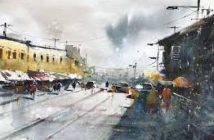

I get a chill just looking across your snowy road. Nice atmosphere.